Hot Men’s Swimwear Trends 2026: Confidence You Can See
Why Men’s Swimwear Matters More in 2026 and What This Article Covers
Men’s swimwear has moved far beyond a basic pair of trunks, and 2026 is shaping up to reward men who want clothing that looks polished, feels comfortable, and handles long summer days without fuss. Designers, sportswear labels, and everyday retailers are all moving toward cleaner cuts, more adaptable fabrics, and richer color stories that work from poolside mornings to late beach dinners. The modern brief for swim style is simple: a good suit now has to do more than swim.
That shift matters because swimwear now sits at the intersection of style, travel, wellness, and practicality. A modern pair of trunks may be worn for an early swim, a boardwalk lunch, a ferry ride, and an impromptu sunset drink without a full outfit change in between. Social habits have changed too. Men are photographed more often in vacation settings, and many now want pieces that feel intentional rather than random. At the same time, shoppers have become more selective. They look for stretch, lining comfort, pocket design, fabric weight, quicker drying times, and flattering cuts instead of buying the first loud print hanging near the checkout line.
This article begins with an outline so the rest of the guide is easy to follow:
- Silhouettes and cuts that are defining the 2026 season, including inseam length and shape.
- Fabric innovations, from performance blends to better linings and more thoughtful sustainability.
- Color, print, and texture directions that look current without feeling costume-like.
- Smart styling advice for different body types, settings, and personal style preferences.
- A practical conclusion for men who want to buy less, choose better, and wear their swimwear with confidence.
Think of 2026 swimwear as a quieter kind of style flex. Instead of shouting for attention, the strongest pieces do their work through fit, finish, and proportion. A slightly shorter hem, a more refined waistband, or a fabric with subtle texture can change the whole impression. The sections ahead break down those details in plain language, compare the most relevant options, and help you figure out which trends are worth following and which are easy to skip.
The Silhouette Shift: Tailored Trunks, Shorter Inseams, and Smarter Proportions
If one trend defines men’s swimwear in 2026, it is the continued move toward better proportion. The oversized, knee-grazing board short has not vanished, but it no longer leads the conversation outside specific surf contexts. In its place, tailored trunks with a cleaner line are taking over. The sweet spot for many men sits between a 5-inch and 7-inch inseam. That range tends to look balanced, feels modern, and works on a wide variety of heights and builds. A 5-inch trunk reads sportier and more fashion-aware, while a 7-inch cut feels a little more conservative and broadly versatile.
The biggest change is not simply that shorts are shorter. It is that they are more deliberate. Waistbands sit flatter, legs taper more neatly, and side vents or curved hems are used with purpose rather than as decoration. A trunk that ends around mid-thigh often gives the leg a longer, cleaner visual line than a longer short that cuts awkwardly at the knee. That is why even men who once preferred extra coverage are increasingly trying slightly shorter options. The effect is less “look at me” and more “this actually fits.”
Several silhouettes stand out in comparison:
- Classic tailored trunks: the most adaptable choice for beach, pool, and resort use.
- Athletic split-hem shorts: ideal for active swimmers and men who prefer easier movement.
- Square-cut swim shorts: a sleek option that bridges sporty and retro influences.
- Long board shorts: still useful for surfing, but less dominant in general style settings.
Retro influence remains important, but in 2026 it appears in a cleaner, less theatrical form. Rather than full throwback costumes, brands are borrowing details from the 1960s through the 1980s: contrast piping, side tabs, shorter hems, and solid colors with crisp trim. The result feels nostalgic without looking like dress-up. This matters because the average buyer is not shopping for a themed photo shoot. He wants a pair of swim shorts that can survive both salt water and honest scrutiny in a hotel mirror.
Practical comparison helps. If you want one do-everything option, a flat-front trunk with a 6-inch inseam is probably the safest and strongest choice. If your style leans sporty, a shorter leg with stretch fabric and a shaped side seam will feel lighter and more current. If you mainly swim laps or prioritize performance, a sleeker cut may work better than an all-purpose beach short. In every case, the winning principle for 2026 is clear: choose proportion over excess fabric, and your swimwear will instantly look more intentional.
Fabrics, Performance, and the Rise of Swimwear That Works Harder
Great swimwear in 2026 is not defined by appearance alone. Fabric technology and garment construction are doing much of the heavy lifting, and this is where many of the most meaningful improvements are happening. Men have become less tolerant of stiff shorts that stay wet too long, balloon in the water, or punish the skin with rough inner mesh. As a result, brands are focusing on lighter weaves, four-way stretch, faster drying, smoother linings, and more secure pocket engineering. The goal is simple: a suit that performs well in motion and still feels good an hour later.
One major shift is the decline of the old scratchy mesh brief liner in favor of softer support systems. Many newer trunks use boxer-brief style compression liners, smoother stretch mesh panels, or removable lining structures that provide support with less irritation. For men who spend a full day in the same suit, this can be the difference between comfort and constant adjustment. It is not a glamorous detail, but it is one of the clearest examples of how swimwear has matured as a product category.
Common materials also tell the story. Recycled polyester and recycled nylon are increasingly used in blends with elastane, allowing fabrics to keep shape while offering better mobility. Textured surfaces such as seersucker-inspired weaves, brushed finishes, and matte technical fabrics are gaining attention because they add visual interest without relying on loud prints. Some garments include laser-cut drainage holes, zip pockets, hidden key loops, or anti-odor finishes, especially in premium and travel-oriented styles.
When comparing fabric choices, these factors matter most:
- Drying speed: lighter technical weaves tend to dry faster than dense, heavy fabrics.
- Stretch level: a moderate stretch blend usually feels better than a completely rigid shell.
- Lining comfort: boxer-style liners often provide better wear for long days than standard mesh.
- Surface finish: matte and textured fabrics generally look more refined than shiny synthetics.
- Durability: tightly woven materials with reinforced stitching often hold color and shape better over time.
Sustainability also remains part of the conversation, but it deserves a clear-eyed view. Recycled material content is a positive sign, yet it should not be treated as the only marker of value. A better-made trunk that lasts for several summers may be more responsible than a cheaper pair marketed with vague eco language but built to fail quickly. In practical terms, men shopping in 2026 should read product descriptions carefully, pay attention to lining and fabric weight, and think about use frequency. The best swimwear now behaves more like thoughtful apparel than a throwaway seasonal purchase, and that is a trend worth welcoming.
Colors, Prints, and Texture: The Visual Language of 2026 Swim Style
The visual mood of men’s swimwear in 2026 feels more curated than chaotic. Bright colors still have a place, especially in tropical destinations and sport-driven collections, but the broader direction leans toward nuance. Instead of blinding neon or oversized novelty graphics, the season favors tones with a sun-faded, mineral, or coastal quality. Think sea-glass green, deep navy, rusted terracotta, washed coral, pale stone, espresso brown, and softened turquoise. These shades feel relaxed and elevated at the same time, which helps explain their growing appeal.
Solid colors are especially strong because they allow fabric, fit, and finish to do the talking. A well-cut trunk in olive, slate blue, or muted red can look more modern than a louder print simply because it feels more confident. That said, prints are not disappearing. They are just becoming more controlled. Smaller geometric motifs, vintage-inspired stripes, abstract wave patterns, and micro florals are replacing the oversized tropical explosions that once dominated every summer rack. The difference is subtle but important: the new print trend complements the wearer instead of competing with him.
Texture is the quiet hero here. A flat solid can look ordinary, while a textured solid can look rich. That is why seersucker-like finishes, crinkled weaves, soft rib textures, and crochet-inspired overlays are showing up more often. Even when the color is restrained, the material adds dimension in sunlight and movement. It is the kind of detail that makes a garment feel considered from a distance and interesting up close.
Some of the most useful color and print directions for 2026 include:
- Monochrome darks such as navy, charcoal, and black for a streamlined, minimalist look.
- Earth-led shades like clay, sage, sand, and cocoa for a mature resort feel.
- Retro stripes and trim for men who want visual identity without loud pattern overload.
- Understated aquatic tones such as teal, lagoon, and faded blue for a fresh but wearable option.
Choosing among these depends on context. A hotel pool or city rooftop setting often rewards cleaner solids and subtle texture. A holiday beach destination can handle stronger color or a more expressive print. Skin tone, tanning level, and personal style also play a role. Darker jewel tones can create a sharper contrast on lighter complexions, while dusty neutrals and sun-washed hues often look especially natural on warmer or tanned skin. The strongest visual lesson for 2026 is not that one color wins. It is that intention wins. When the palette, fabric, and fit all agree with each other, the whole look reads as confident rather than accidental.
How to Wear the Trends Well and What Men Should Actually Buy for Summer 2026
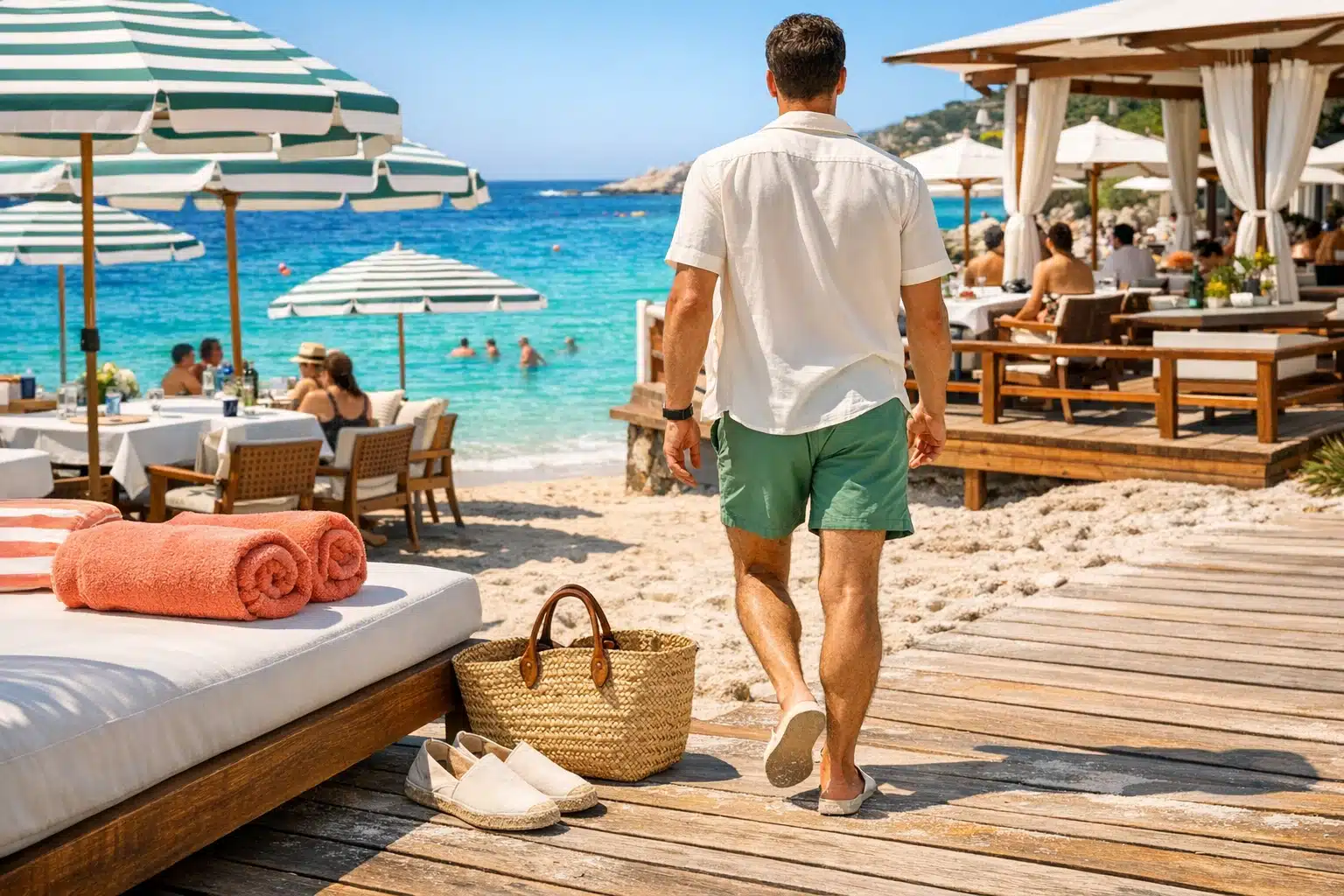
Trends become useful only when they survive real life, and this is where smart styling matters. The best men’s swimwear in 2026 is not meant to live in isolation. It works as part of a broader warm-weather wardrobe. That means a good pair of trunks should pair easily with a camp-collar shirt, a lightweight knit polo, a clean tank, or an open linen button-up. Footwear matters too. Minimal leather slides, simple sport sandals, and clean canvas espadrilles all support the more polished direction of modern swim style better than tired flip-flops worn long past their prime.
Versatility is a major buying theme. Many men are looking for one or two pairs that can cover multiple settings instead of five random options. If that sounds familiar, build from use case. For regular pool sessions, choose a streamlined trunk or square-cut style with performance fabric and secure support. For beach holidays, a tailored 5-inch or 6-inch short in a solid or controlled print is the strongest all-rounder. For resort travel, lean into texture, elevated color, and details such as side tabs, matte hardware, or a refined waistband. Each one sends a slightly different signal, yet all fit within the same broader 2026 mood.
A smart shopping checklist helps keep the decision practical:
- Try the suit on dry and sit down in it, because waistband comfort changes with posture.
- Check where the hem lands on your thigh rather than focusing only on the number on the label.
- Look inside for liner construction, seam quality, and pocket bulk.
- Ask whether you can wear it with at least two tops you already own.
- Choose color with intention: one versatile neutral and one more expressive option is often enough.
Just as important is knowing what to avoid. Overdesigned trunks with too many zips, giant logos, or gimmicky prints often date quickly. Ultra-thin fabrics can look cheap, especially when wet. Very long shorts may still suit specific sports, but they can make casual beachwear look stuck in an older era. On the other end, extremely tight or overly brief styles are best chosen deliberately, based on comfort and setting, not because a trend cycle briefly put them in the spotlight. Confidence is usually strongest when the wearer looks at ease rather than overly styled.
For men updating their summer wardrobe in 2026, the clearest conclusion is this: buy swimwear the way you would buy good everyday clothing. Prioritize fit, fabric, function, and color harmony over noise. A mid-thigh tailored trunk, a comfortable liner, a refined texture, and a wearable palette will take you much further than a pile of impulse buys. When your swimwear feels like an extension of your personal style instead of a seasonal afterthought, the confidence shows before you even reach the water.